
Every Day, Your Site
Loses Time
Nobody Records
A delivery ninety minutes late. A pour that never started. The same reason three weeks running that nobody counted.
SiteVector records it as it happens, so the day gets entered once instead of rebuilt from memory at five o'clock.
Put it on a project you are already running. 60 days, no card.
Hosted in Australia. Your data is stored in Sydney and never leaves the country.
Nobody wrote it down.
Sites lose time in increments too small to bother recording. Ninety minutes here, a morning there. Each one is minor on the day and forgotten by Friday. By the time the pattern matters the person who knew has moved to another job.
That is not a lack of effort or judgement. The information simply was never captured in a form anyone could pull later.
Every Project Speaks the Same Language
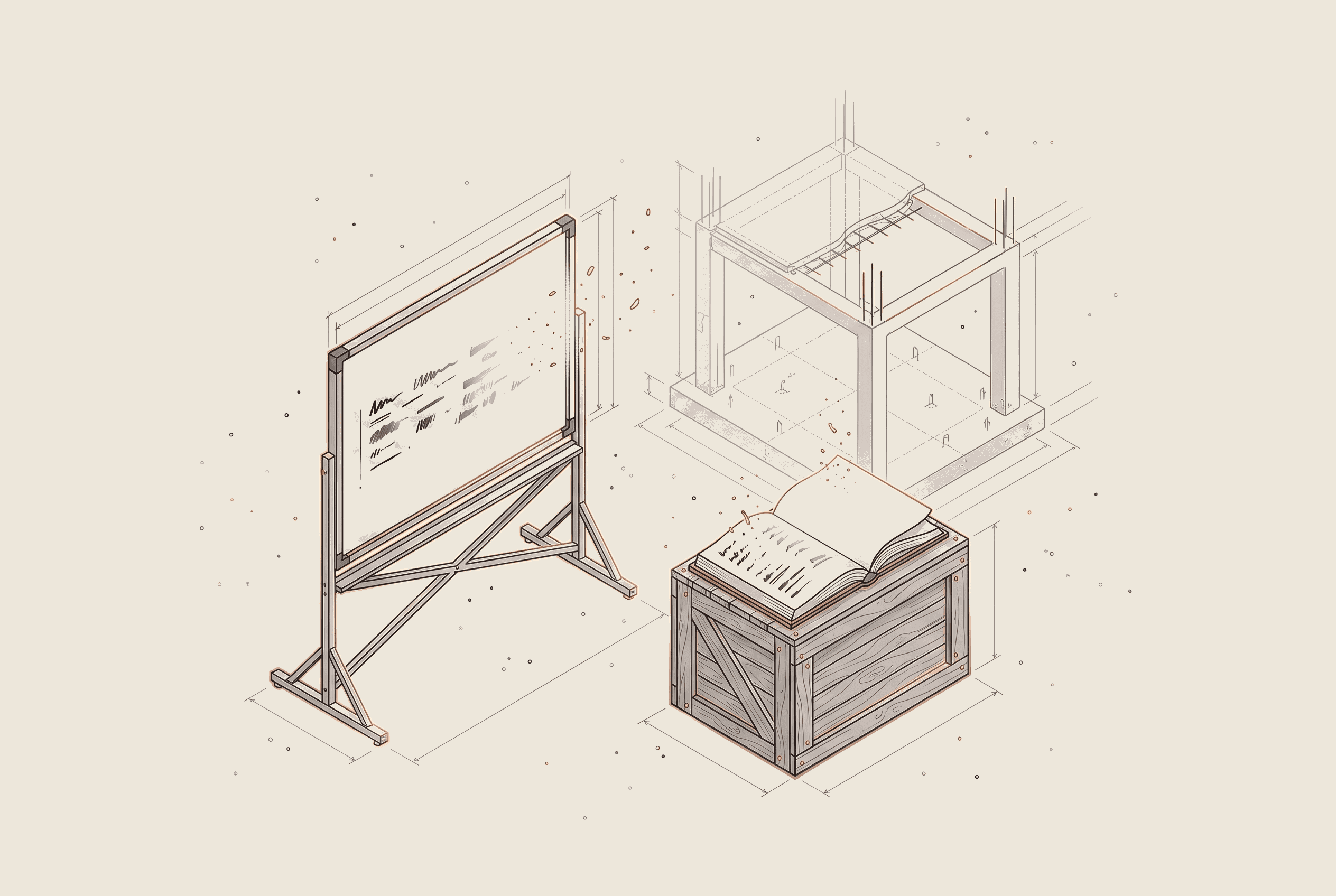
Construction projects are run by experienced people making good decisions every day. The gap is rarely judgment. It is having a consistent, structured record of what actually happened to back that judgment up. Delayed programmes, disputed records and missed patterns are usually the result of data that was never captured, not decisions that were never made.
SiteVector records what actually happens on site, every day, using the same structure across every project. Not your structure, your subcontractor's structure or someone else's spreadsheet. One consistent record. The same reason codes. The same delivery classifications. The same trade categories. Which means the data from your project in January is directly comparable to the data from your project last year, or the one starting next month.
The data is structured. The judgment stays human.
What you get out of it
Three things. All of them come from the record your site team is already making while doing their normal job.
Less five o'clock admin
The team records deliveries and task outcomes through the day. The diary is built from what they entered rather than reconstructed from memory after the site closes.
Fewer surprises on Friday
A delivery that did not arrive, a task that did not start, a trade sitting blocked. Recorded as it happens, so the project manager sees it while there is still time to respond.
Something to compare it to
The same reason codes and classifications on every project, so this job can be set against the last one. Your first project gives you information. Your next gives you something to measure it against.
What gets measured, gets improved.
A day on site, recorded as it happens.
6:47am
Gatekeeper
First delivery logged. Three taps.
10:15am
Site Manager
Concrete pour marked In Progress, photo attached.
2:30pm
Site Manager
Blocked task logged with the reason and the trade responsible.
4:55pm
Site Manager
End of Day lock. The record is sealed.
5:00pm
Project Manager
Reads the shift diary before leaving the office. Nobody wrote a report. The team recorded what happened as they went and SiteVector turned it into the report.
6:47am
Gatekeeper
First delivery logged. Three taps.
10:15am
Site Manager
Concrete pour marked In Progress, photo attached.
2:30pm
Site Manager
Blocked task logged with the reason and the trade responsible.
4:55pm
Site Manager
End of Day lock. The record is sealed.
5:00pm
Project Manager
Reads the shift diary before leaving the office. Nobody wrote a report. The team recorded what happened as they went and SiteVector turned it into the report.
For contract administrators
Stop reconstructing what happened six months later. When somebody asks why an activity was delayed, the answer is a record of what was entered on the day rather than a search through emails, photos, message threads and somebody's memory.
Nobody has to go and assemble it. It was captured while the project was running, by the people who were there.
Illustrative example · 8 May
- Delivery scheduled
- 07:00 to 08:00
- Arrival
- 08:17
- Issue recorded
- Supplier delay
- Affected task
- Concrete pour, Zone B
- Task outcome
- Not started
- Reason selected
- Delivery Not Made
- Photograph attached
- Yes
- Docket attached
- Yes
- Day sealed
- Yes, 17:04
An example of the shape of a record, not a real project.
Zero integration by design.
You do not need to change the way your company manages projects. Already running Procore, Aconex, Jobpac, Cheops or P6. Keep it.
SiteVector sits underneath and records the ground level detail those systems were never designed to capture, then hands it back structured. It runs in a browser, so there is nothing to install, no corporate IT sign-off and no connection to build. A new project is live in under 5 minutes and exports to Excel any time, ready for Power BI or whatever you already report in.
For teams that have sat through enough software implementation projects to know what they cost, that matters.
Row-level isolation
Each organisation's data is completely isolated. No project can see another's records.
Tamper-evident records
Days lock at EOD. Every unlock is permanently logged with a timestamp, a reason and the user who made the change.
Hosted in Australia
Site data is stored in Australian cloud infrastructure and does not leave it.
Yours to export
Download your complete project data as Excel, Word or PDF at any time.
Gate Operator
Logs the delivery.
Site Manager
Records what the trades completed and why anything did not get done.
Project Manager
Sees programme health in real time without waiting for a Friday update.
Construction Manager
Looks across every active project in the portfolio and sees the same consistent picture from each one.
From the gate to the boardroom.
SiteVector covers the full operational hierarchy on a construction project. The gate operator logs the delivery. The site manager records what the trades completed and why anything did not get done. The contract administrator has a timestamped, tamper-evident record for every delivery and task, ready for claims, variations and dispute resolution without any additional work. The project manager sees programme health in real time without waiting for a Friday update. The construction manager looks across every active project in the portfolio and sees the same consistent picture from each one.
No chasing. No reformatting. No translating one project manager's spreadsheet into another's format. One structure, used the same way on every project, readable at every level.
Sealed at the end of the day.
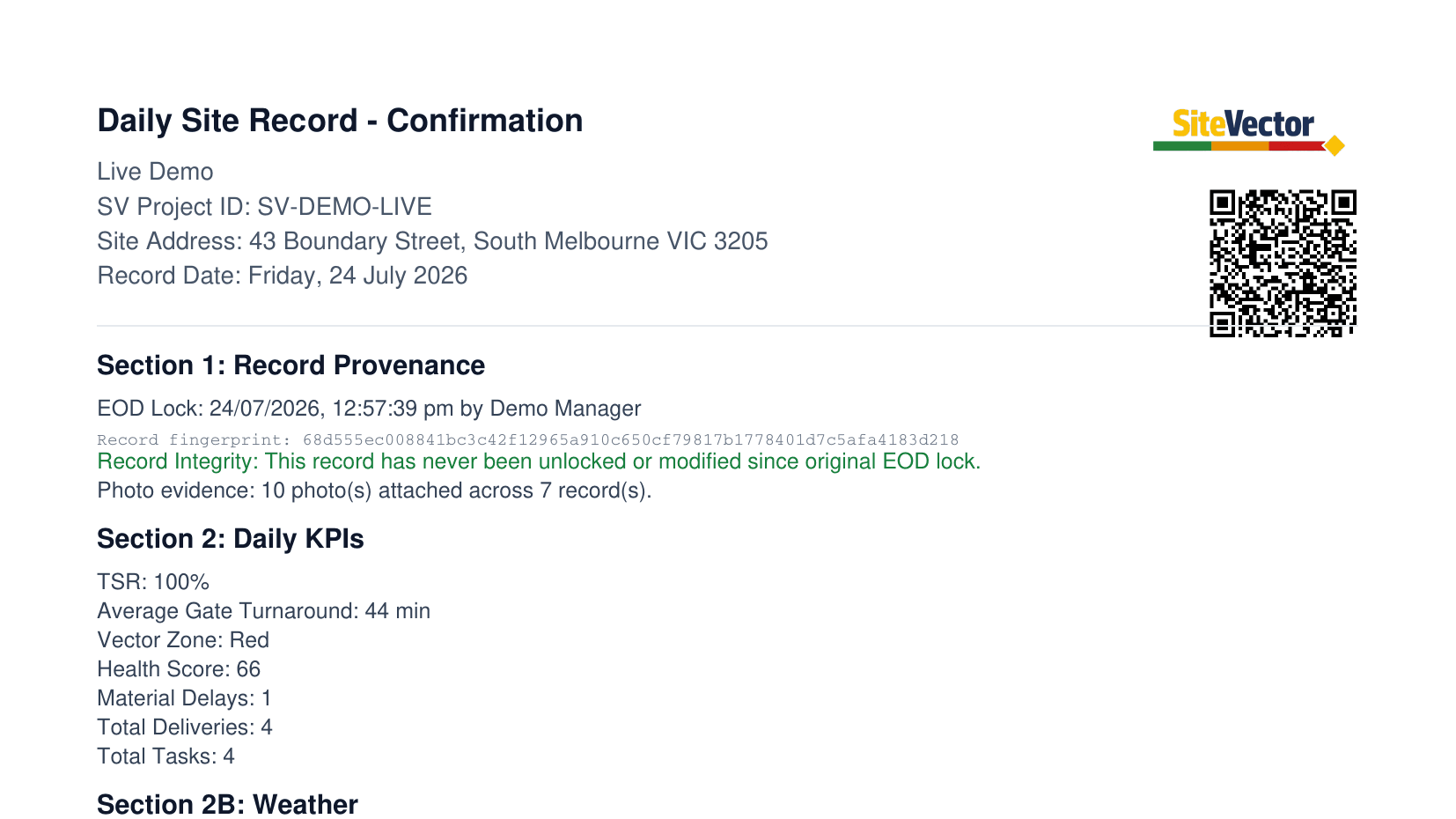
Every day ends the same way: the site manager locks and seals the record, creating a tamper-evident account of the day. Once sealed, no entry can be changed. Every amendment after that point is permanently logged with a timestamp, a reason and the name of who made the change.
The Day Record PDF is generated automatically from the day's actual entries: every delivery, every task outcome and every reason code, structured and timestamped, ready when a variation is disputed, an EOT is assessed or a Security of Payment claim is tested.
Every sealed Day Record also carries its own QR code, a verifiable fingerprint anyone can check with no login required. Scan it and a contract administrator, an adjudicator or an opposing expert can confirm in seconds that the record still matches what was sealed. Verify a record.
Try it on a project you are already running
Run SiteVector alongside your existing process for 60 days. Do not wait for a new project to start, do not replace anything and do not make a company-wide decision. See what gets recorded and whether the site team finds it quicker than what they do now.
60 days · No card required · Nothing to install